

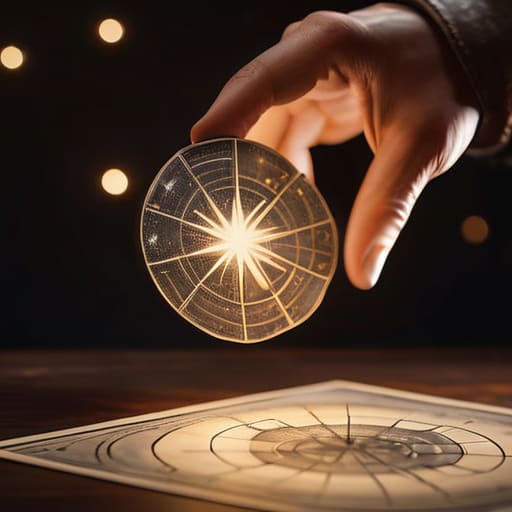
I remember sitting at my mother’s kitchen table in 1984, surrounded by the smell of old paper and tea, staring at a paperback that promised my entire future was written in the stars. It was terrifying, really—the idea that a celestial alignment could strip away my agency. For years, I watched people treat astrology like a divine script they were forced to follow, rather than a tool for reflection. I’ve spent two decades in libraries and behind my own card index realizing that most of the fear comes from bad writing. There is a massive difference between reading a map and being told you have no choice in which direction to walk, and I believe there is immense value in using a chart without believing in fate.
In this series, I am not going to offer you cosmic prophecies or tell you that the planets are pulling your strings. Instead, I’m going to show you the mechanics of the math—how the ephemeris works, how the houses are calculated, and where the data actually ends. My promise to you is simple: I will provide a plain-English look at what the symbols represent, so you can decide for yourself what they mean. We are going to treat the chart like a weather report, not a decree.
The Geometry of the Self Using a Chart Without Believing in Fate

When I look at a chart, I don’t see a script for a play that has already been written; I see a complex web of geometric relationships. If you look at the aspect patterns—those lines connecting the planets—you aren’t seeing “destiny” etched in stone. You are seeing the mathematical tension between different parts of a personality. For instance, a square between Mars and Saturn isn’t a curse that will prevent you from succeeding; it is simply a description of a recurring friction between your drive to act and your need for structure. I view this process as navigating natal chart archetypes, where the planets act more like characters in a novel rather than puppeteers.
This is where I find the most value in astrology as a psychological tool. Instead of asking, “What is going to happen to me?” I prefer to ask, “How do these internal pressures manifest in my behavior?” By identifying these patterns, you aren’t surrendering to the heavens; you are actually gaining astrology for personal agency. You are learning to recognize the weather before the storm hits, which gives you the chance to decide how you want to stand in the rain.
Astrology as a Psychological Tool for Honest Self Examination

When I sit down with a client’s chart, I treat it less like a crystal ball and more like a complex, symbolic mirror. I’ve spent enough years in libraries to know that a map isn’t the territory; it’s just a representation of it. If we treat astrology as a psychological tool, the planets stop being little gods demanding obedience and start acting as a shorthand for the internal tensions we all carry. Instead of saying, “Mars is making you angry,” I prefer to look at where that Mars sits in the houses and ask, “Where is your drive being blocked or redirected?” It’s about identifying astrological patterns for self-awareness rather than predicting a predetermined catastrophe.
This approach shifts the focus from what is happening to you to how you are responding to what is happening. By navigating natal chart archetypes, you aren’t looking for a script to follow, but rather a vocabulary to describe your own recurring behaviors. It allows you to look at a difficult transit and ask, “What part of my character is being tested right now?” This is where the real utility lies—not in the prediction, but in the reflection.
Navigating Natal Chart Archetypes Without Surrendering Your Will

When I sit down with a client, the first thing I do is write their birth time down twice—once on my notepad and once on my index card. I do this because that precision is the only thing that matters; without the exact moment, the mathematical placement of the houses falls apart, and we’re just guessing. Once we have the math settled, we encounter the archetypes: that heavy Mars in Aries or that cautious Saturn in Capricorn. It is tempting to look at these placements as fixed personality traits, as if you were born with a certain set of hardware that cannot be upgraded. But I prefer to view navigating natal chart archetypes as a study of tendencies rather than a set of handcuffs.
Think of these planetary positions as a set of recurring themes in a book you are currently writing. A strong Neptune influence might suggest a natural inclination toward escapism or artistic sensitivity, but it doesn’t mean you are destined to lose touch with reality. By treating astrology as a psychological tool, you can identify these patterns without letting them dictate your movements. The chart shows you the weather, not the destination; it identifies the currents in the water, but you are still the one holding the rudder.
Distinguishing Cosmic Weather vs Free Will in Daily Life
When I look at a transit chart, I don’t see a list of things that are going to happen to you; I see a shift in the prevailing atmospheric conditions. Think of it like the weather. If a storm front is moving in, the meteorology doesn’t force you to stay indoors, but it does explain why you might feel a sudden, heavy urge to withdraw or why the wind is picking up. This is the core of understanding cosmic weather vs free will. The planets might signal a period of high tension or restless energy, but they don’t hold the steering wheel. You do.
I’ve spent years cross-referencing transits with my card index, and what I’ve found is that reinterpreting planetary transits as internal moods rather than external mandates changes everything. If Saturn is squaring your Sun, you might feel a sense of restriction or a sudden bout of self-doubt. Instead of saying, “Saturn is blocking my career,” try asking, “Why am I suddenly being so hard on myself?” This approach turns the chart into a way of navigating natal chart archetypes with intention, allowing you to observe the pressure without being crushed by it.
Astrological Patterns for Self Awareness and Objective Observation
When I look at a client’s chart, I’m not looking for a script of what will happen; I’m looking for the recurring themes that tend to show up when they are under pressure. I like to think of these as astrological patterns for self-awareness. For instance, if someone has a heavy concentration of planets in Saturn-ruled signs, they might notice a tendency to be overly self-critical or cautious. Recognizing this isn’t about accepting a “destiny” of hardship; it’s about identifying a habitual mental loop. Once you see the pattern, you can actually step outside of it.
This is where the real work begins—moving from passive observation to active engagement. By reinterpreting planetary transits as seasonal shifts in temperament rather than external commands, you reclaim your footing. If a transit feels heavy, I don’t tell people to sit back and wait for it to pass. Instead, I suggest they look at how that specific energy might be nudging their existing tendencies. It turns the chart into a mirror for objective observation, helping you see the shape of your own reactions before they become automatic.
Reinterpreting Planetary Transits Through the Lens of Personal Agency
When I look at a transit report, I don’t see a list of upcoming catastrophes or guaranteed triumphs. Instead, I see a series of mathematical intersections. If Saturn is currently squaring your natal Sun, the math tells us that the tension between your core identity and your external responsibilities is reaching a peak. This isn’t a decree that you will lose your job; it is simply a calculation of where the pressure is likely to manifest. By reinterpreting planetary transits as periods of increased friction rather than fixed outcomes, you shift from being a victim of the clock to an observer of your own internal climate.
I often tell people that a transit is less like a lightning strike and more like a change in the tide. You cannot stop the water from rising, but you can decide whether to build a boat or simply learn to swim. Using astrology for personal agency means acknowledging that while the “cosmic weather” might be stormy, you are the one holding the rudder. The chart provides the coordinates of the storm, but the direction you steer is entirely your own.
The Limits of the Calculation Where the Data Ends
I’ve spent many afternoons cross-referencing old paperbacks with the actual ephemeris, and if there is one thing I’ve learned, it’s that a calculation is only as good as the data it receives. A chart is a snapshot of a specific moment in time—a mathematical arrangement of celestial bodies relative to a fixed point on Earth. It tells you where the planets were, but it cannot tell you what a person does with that position. You can calculate a Saturn return to the exact minute, but the math won’t tell you if that person will meet that challenge with resilience or if they will simply hide under the covers.
This is where we must be careful not to mistake a symbol for a destiny. When I am navigating natal chart archetypes, I am looking at a set of energetic tendencies, not a pre-written script. The data ends at the boundary of the individual’s consciousness. We can map the “weather,” but we cannot map the person’s decision to open an umbrella or walk straight into the rain. Recognizing these boundaries is essential for anyone using astrology for personal agency; once you realize the math is a map and not the terrain itself, you can finally stop looking for instructions and start looking for possibilities.
The Map is Not the Journey
A birth chart isn’t a blueprint for a life already lived; it’s more like a weather report for a landscape you haven’t finished walking through yet. I’m not interested in telling you what the planets have planned for you—I’m interested in showing you the mathematical patterns they reveal, so you can decide which way you actually want to turn when the wind picks up.
Rosalind Teague
The Map is Not the Territory
We have spent a good deal of time looking at the mechanics—the way the planets sit in their houses, the geometry of the aspects, and the mathematical reality of transits. I want to reiterate that a birth chart is not a blueprint for a pre-written life; it is more akin to a topographical map of your internal landscape. It shows where the mountains are steep and where the rivers tend to flood, but it says absolutely nothing about which path you will choose to walk. By separating the data from the destiny, we can use these patterns as tools for objective observation rather than as excuses for our shortcomings or as scripts for our successes.
At the end of the day, my card index is full of charts, but none of them contain a person’s soul or their capacity for change. Astrology can give you a vocabulary for your experiences, but it cannot provide the meaning behind them. I hope you use these calculations to look more closely at yourselves, but I also hope you remember that you are the one holding the pen. The chart shows you the weather, but you are the one who decides whether to build a shelter or to step out into the rain.
