


I remember sitting in the back of my mother’s study in 1978, watching her meticulously cross-reference a handwritten transit chart against a thick, cloth-bound ephemeris. She didn’t treat the planets like fickle gods; she treated them like data points. It was there I first realized how much the modern world loves to dress up simple power structures in mystical lace. People talk about mentor and student dynamics as if they are cosmic destinies or soul-contracts written in the stars, but usually, it’s just a matter of how two people manage the weight of knowledge and the inevitable friction of ego. We tend to romanticize the “guide” and deify the “seeker,” ignoring the very real, very human mechanics of how influence actually moves from one person to another.
I am not here to tell you if you are destined to find a spiritual master or if your teacher is your karmic opposite. Instead, I want to look at the structural reality of these connections through the lens of the chart. I will show you where the authority sits, where the communication gaps are likely to form, and exactly how the planetary placements suggest the flow of energy between you. My goal is to give you the unvarnished mechanics of the relationship, so you can decide for yourself whether the connection is worth your time.
The Mechanics of Influence Mapping Mentor and Student Dynamics

When I look at a chart to understand a connection between a teacher and a pupil, I don’t start with “destiny.” I start with the planets that govern the exchange of information. We look primarily at Mercury, the messenger, and Jupiter, the expander. In a synastry overlay—which is just a fancy way of saying we are laying one person’s planetary positions over another’s—we are looking for specific mathematical angles. If a mentor’s Jupiter sits in a harmonious aspect to a student’s Mercury, the knowledge transfer processes tend to feel fluid, almost instinctive. It isn’t magic; it is simply a structural alignment that favors the ease of communication.
However, I always warn my clients that a “good” aspect isn’t always a “kind” one. A square between Saturn and the student’s Sun might indicate a heavy, restrictive pedagogical relationship pattern. It can feel like a weight, or a constant pressure to perform, but that friction is often exactly what produces the most significant growth. I look for these astrological indicators of wisdom not to predict success, but to identify where the friction will likely occur. The chart shows you the architecture of the tension; it doesn’t tell you if you’ll eventually learn to build something beautiful within it.
Tracing the Lines Astrological Aspects of Mentorship in the Chart

When I look at a chart to find these connections, I’m not looking for a magical “teacher” symbol. Instead, I look at the geometric relationships—the aspects—between the planets that govern how we receive and distribute information. Often, I see a heavy emphasis on Jupiter, the planet of expansion and philosophy, or Mercury, the messenger. If a person’s natal Mercury is making a tight trine to another’s Jupiter, it suggests a certain ease in the knowledge transfer processes between them. It doesn’t mean they are destined to be in a classroom together; it simply means the intellectual frequency they operate on is tuned to the same station.
However, the friction is often more revealing than the ease. I pay close attention to Saturn, which represents structure, boundaries, and the weight of time. A square between Saturn and a student’s personal planets can manifest as a heavy, demanding pedagogical relationship pattern where the student feels the pressure of expectation. These astrological indicators of wisdom aren’t guarantees of success, but they do show where the resistance lies. I find that the most profound learning usually happens in those difficult aspects, where the student has to work to integrate the authority being offered.
Calculating Wisdom Identifying Astrological Indicators of Wisdom and Author
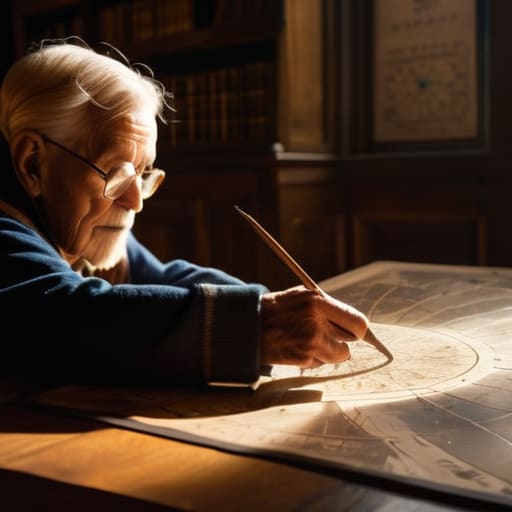
When I look for wisdom in a chart, I don’t look for a magical sign that says “this person is a genius.” Instead, I look for how a person handles the weight of what they know. In my practice, I focus heavily on the relationship between Jupiter and Saturn. Jupiter provides the expansive, philosophical breadth, while Saturn provides the structure and the discipline to actually hold that information. When these two planets form a strong aspect, you see the astrological indicators of wisdom manifest as someone who doesn’t just possess facts, but understands how to organize them into a usable framework. It isn’t about being “smart”; it is about the capacity for endurance in thought.
I also pay close attention to the placement of Mercury in relation to the Midheaven. If Mercury is well-aspected to the MC, the individual often possesses a natural authority in how they communicate specialized knowledge. This is where the knowledge transfer processes become visible in a chart. We aren’t looking at destiny here, but rather at the psychological plumbing of how a person transmits information. I find that seeing these patterns helps clarify why some people command a room through sheer expertise, while others struggle to make their insights stick.
Where Cognition Meets Cosmos Educational Psychological Dynamics Explained
When we look at a chart to understand a teacher-student relationship, we aren’t looking for a psychic blueprint of destiny; we are looking at the cognitive scaffolding. In my years in the library, I saw how different minds require different structures to hold information. In astrology, this mirrors the way we interpret educational psychological dynamics through the lens of the planets. It isn’t just about whether a person is “smart,” but about how they process the transfer of knowledge. A Jupiter-dominant student might crave the grand philosophy, while a Saturn-heavy mentor demands the grueling, repetitive labor of foundational mastery.
The friction often arises not from a lack of intelligence, but from a mismatch in these pedagogical relationship patterns. If a mentor’s chart shows a heavy emphasis on Mercury—quick, lateral, and conversational—but the student’s chart is dominated by fixed Earth signs, the mechanism of learning will feel broken. The student isn’t being difficult; they are simply processing at a different frequency. I don’t believe the stars dictate the lesson, but they do reveal the temperament of the classroom.
Decoding the Connection Mentor Student Compatibility Charts and Their Limit
When I sit down with two separate charts—the teacher’s and the student’s—I am not looking for a “soul connection.” I am looking for the friction and the flow. To build mentor student compatibility charts, I start by overlaying their planets, specifically looking at how the student’s Saturn or Jupiter interacts with the mentor’s natal placements. It is a mathematical exercise in seeing where one person’s structure meets another person’s need for growth. If the student’s Mercury forms a tight aspect to the mentor’s Sun, the knowledge transfer processes tend to be efficient; the language is shared. If they are in opposition, the lesson might come through conflict rather than lecture.
However, I must be clear about the boundaries here. A chart can show you the potential for a productive pedagogical relationship pattern, but it cannot predict if a mentor will actually be kind or if a student will be lazy. These charts identify the astrological aspects of mentorship—the energetic “weather” between two people—but they don’t account for human character. I can show you where the intellectual sparks are likely to fly, but I cannot tell you if the flame will actually catch.
The Flow of Information Analyzing Knowledge Transfer Processes
When we look at how knowledge actually moves from one person to another, we aren’t just looking at a lecture or a textbook; we are looking at the plumbing of the psyche. In a chart, this is often where the Mercury-Jupiter connections come into play, acting as the conduits for these knowledge transfer processes. I tend to look at how a person’s Mercury interacts with the other person’s Saturn or Jupiter to see if the information is being received as a gift or as a heavy, unyielding weight. It isn’t about whether the student is “smart” enough, but rather how the receptivity of the container allows the data to settle.
If the Mercury of the mentor is squaring the Mercury of the student, you will likely see a friction in how facts are processed—one person speaks in abstractions while the other demands granular detail. These pedagogical relationship patterns aren’t destiny, but they do show us where the communication might clog. I don’t believe a difficult aspect means a failed connection; it simply means you have to account for a different frequency of understanding before the lesson can truly take root.
Recognizing the Patterns Teacher Student Relationship Astrology and Pedagog
When we look at the intersection of a chart and a classroom, we have to move past the idea of “destiny” and look at the actual architecture of how a person receives information. In my experience, pedagogical relationship patterns aren’t found in a single lucky planet, but in how the natal Saturn—the planet of structure and discipline—interacts with the Mercury of the instructor. If a student’s Mercury is in a tense aspect to a teacher’s Saturn, they aren’t “cursed” to fail; rather, the chart is simply signaling a friction point where authority might feel heavy or restrictive.
This is where the math meets the classroom. We aren’t looking for a magical bond, but for the specific mechanisms of learning that the symbols suggest. For instance, a student with a highly receptive Moon might thrive under a mentor who uses an intuitive, nurturing approach, whereas a more analytical, Saturnian student might find that same warmth distracting or imprecise. By identifying these teacher student relationship astrology markers, we aren’t predicting success, but we are identifying the specific cognitive hurdles that might appear when two different ways of processing the world collide.
The Friction of Growth
A chart can show you where the authority sits and where the curiosity resides, but it cannot tell you if a student will actually listen or if a mentor will actually lead; it only maps the potential for the collision between the two.
Rosalind Teague
Beyond the Ephemeris
We have looked at the mechanics of how these connections manifest, from the specific planetary aspects that signal authority to the psychological frameworks that govern how we actually absorb information. I have shown you how to track the flow of knowledge through a chart and where the mathematical limits of compatibility lie. But remember, a chart is merely a map of potential energies, not a script for your life. Identifying a strong Jupiter-Saturn connection between two people tells you that the structural capacity for mentorship exists, but it does not guarantee that either person will show up to the work. The astrology provides the architecture, but the actual lived experience is built by the people standing within it.
Ultimately, whether you are the one guiding or the one learning, the goal isn’t to find a perfect cosmic alignment that eliminates all friction. Friction is often where the most profound growth occurs. Use these tools to understand the currents you are swimming in—to see where the power lies and where the gaps in understanding might emerge—but do not let the symbols make your decisions for you. The stars may offer a blueprint of the terrain, but you are the one who must choose which path to walk and how much of yourself to invest in the journey.
